
This post contains affiliate links. If you make a purchase, I may earn a small commission at no additional cost to you. As an Amazon Associate, I earn from qualifying purchases.
When I first arrived in Thailand, I thought I knew how to eat Asian food. I’d used chopsticks plenty of times at restaurants back home, so I figured I was all set.
But on my very first meal in Bangkok, I sat down, looked around, and realized no one was using chopsticks. Not a single person.
Wait, what?
Like so many western travelers, I’d assumed that since Thailand is in Asia, they must use chopsticks too. Turns out, I was wrong.
Thai people don’t typically use chopsticks. They only come out for certain dishes, usually Chinese food or noodles served in soup. Otherwise, it’s all about the spoon and fork.
I had no idea! It’s actually only a few countries like China, Japan, and Korea that use chopsticks as their main utensil.
My gosh, I love traveling solo: I’m always learning something new.
And there’s so much more to Thai food etiquette than just chopsticks. If you want to eat like a local and not stand out at every street stall, keep reading. These tips will help you blend right in, at least at the dinner table.
RELATED POST: 10 Tips to Master Eating Alone While Traveling
Table of Contents
Do Shoes Stay On or Off?
Usually, your shoes will stay on when you go to a Thai restaurant, but it’s a good idea to look at the entryway first. If you see a shoe rack or rows of shoes outside, you’ll want to take your shoes off too.
Some smaller cafes will even be set inside people’s homes. And if you’re going in someone’s home, you should always take your shoes off.
Leaving your shoes on would be considered disrespectful
Be Sure you Greet the Host
In Thai dining, it’s customary to greet the host. When greeting the host, you should put your hands together like you are going to pray, then take a very small bow forward.
There is also only one Thai traditional greeting that is used for everyone and everything. Yup, just one. “Sawasdee.”
Thais don’t say something different for “Good morning,” or “Good afternoon,” or “Hello.” They just say “Sawasdee” and follow it with “ka” if they are female, or “krub” if they are male.
So, if you are greeting someone in Thailand this is what you would say:
- If you are female, you would say “Sawasdee ka”
Pronounced as “Sah-wah-dee Khaaa” - If you are male, you would say “Sawasdee krub”
Pronounced as “Sah-wah-dee Khrap”
This makes it easy since you’ll only need to learn that one basic greeting!

No Chopsticks
Surprisingly, Thai people do not use chopsticks as often as you think. The only time you’ll see Thais use chopsticks is when they are eating Chinese food (duh!) or noodle soups.
Chopsticks just aren’t a thing in Thailand. The Thai utensil of choice is a spoon.
Really…a Spoon?
Yes, that’s correct. Not a fork, but a spoon. Thai people will primarily use a spoon to eat with. The fork is only used as a shovel to push food onto the spoon. And since Thai food is already bite size, there is no need for a knife.
And those noodle soups? They still use chopsticks, but they use them to put the noodles onto their spoon.
Don’t Ask for Salt and Pepper
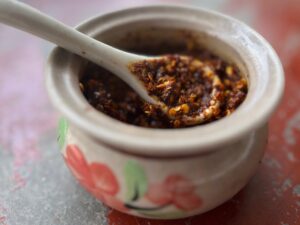
You’re not going to find salt and pepper shakers on the dining table. Thailand’s equivalent to salt and pepper is fish sauce and Thai chilis. There will be little jars of them on every table.
You may find the fish sauce and chilis already mixed together or they may be in separate jars ready for you to combine on your plate.
And watch out – those Thai chilis are spicy hot!
You May be Sitting on the Floor
Not all restaurants in Thailand have standard tables and chairs like you would see in a restaurant in the United States. Some will have a table low to the ground, more like a large coffee table, and there will be floor pillows scattered around for you to sit on.
If you find yourself sitting on a mat or pillow on the floor, it’s important to make sure you don’t point the bottom of your feet at anyone. Stretching your feet or legs out in front of others is considered offensive and rude in Thailand.
You should sit with your legs tucked to the side or sit criss-cross-applesauce.
You Eat Rice with your Hands
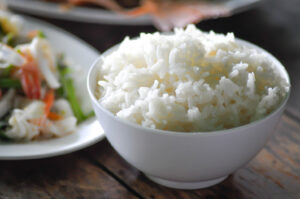
If it’s sticky rice, it’s eaten with your hands! Ball it up, then make it into a pinch pot and use it as a little edible spoon to eat.
Any other type of rice you will use a spoon, making sure that the fork is only used to push the rice onto the spoon.
You Have to Ask for the Check
In Thailand, eating is a social activity and isn’t rushed, so you’ll likely need to let the host know when you are ready for the check. The international “air check mark” works here just like it does everywhere else.
Don’t be caught off guard when you look at the bill either. Restaurants are allowed to add a VAT (value added tax) and a 10% service charge to your bill, if they prominently display the fee to customers.
Considering how inexpensive food is in Thailand, this may only amount to a few cents. Not all restaurants add the tax either. When I went to Bangkok, only about half of the places I ate at added the tax on. It’s just something to be aware of.
Tipping isn’t Customary
Thailand does not have a tipping culture, and tips are not expected.
If you do decide to tip, it should only be loose change or a small bill. Tipping is not percentage based like it is in the US.
Leaving 20 Baht (about .55 USD) is appropriate if you want to leave a little “Thank you.”
***
There you have it. My tips for eating like a local in Thailand.
Have you been somewhere with different customs surrounding food? Let me know in the comments below. I’d love to hear about your experience!